
1Wings
Three-section, against leaks at the edges.
We opened the registration certificates, took apart the layers and the chip, and compared them with a gynecologist’s general hygiene advice
In brief
“The index of local irritant effect on the skin is 0. The sensitizing capacity index is 0.” This is what the state registration certificate RU.01.PA.02.012.E.000053.09.24 records as the requirements for WHIEDA anion pads for day and night wear, and the certificate confirms that the pads meet them. The anion pads have passed a sanitary check for irritation, allergenicity, formaldehyde and microbes; they have no therapeutic purpose, and anything concerning symptoms is decided by a gynecologist.
The manufacturer states nine layers and a thickness of one millimeter. This count includes the wings, the adhesive and the film of the individual packaging. In order, as in the official description:
1Wings
Three-section, against leaks at the edges.
2Top
Cotton with a porous structure — the part that touches the skin.
3Chip
The layer that gives anion pads their name.
4Airlaid
Nonwoven fabric made of softwood cellulose.
5Superabsorbent
Polymer from the Japanese company Sumitomo.
6Base
Nonwoven material wrapped in absorbent paper.
7Bottom film
Microporous: according to the description, it holds liquid and lets air through.
8Adhesive
Without a fluorescent agent, under a peel-off paper.
9Packaging film
Each pad has its own, moisture-resistant one.
The chip’s composition in the official description is five items: anions, infrared range, magnetic component, nano-silver, Chinese yew. It is supposed to activate from body heat, from friction and from moisture — this is stated in the same place.
The superabsorbent is sodium polyacrylate from Sumitomo Seika. The company makes it for baby diapers and sanitary pads: the polymer binds water into a gel and holds a mass of it hundreds of times its own.
For daily liners the manufacturer counts six layers: spunlace with cotton, the same chip, absorbent material, microporous film, adhesive with peel-off paper and packaging film.
The pads are made by Foshan Yurun Sanitary Article Co., Ltd., a factory in the city of Foshan, Guangdong province. In Russia they were registered by LLC “Garmoniya”. In the documents the line is called Anion+.
The line has two state registration certificates. Both were issued on 25 September 2024 by the Rospotrebnadzor Office for the Republic of Adygea; the validity period is unlimited.
Day and night pads Anion+. Open PDF ↗
Daily liners Anion+. Open PDF ↗
The certificate is issued on the basis of an expert opinion and a test protocol of an accredited laboratory. For day and night pads these are opinion No. 000422 of 6 March 2023 from LLC “Expert-Yug” and a protocol from the laboratory “Light Group”. The protocol itself is not attached to the certificate. On the third page is a table of requirements that the pads meet; it contains no measured values.
Skin
Skin irritation, ability to cause allergy, irritation of the eye mucosa: the requirement for all three indices is 0 points.
Chemistry
Formaldehyde that passes from the pad into water: the requirement is no more than 0.1 mg per cubic decimeter. The water extract must be clear, without turbidity, and odor is not permitted.
Microbes
Enterobacteria, Staphylococcus aureus, Pseudomonas aeruginosa, mold and yeast are not permitted. The total number of microorganisms is no more than one hundred per square centimeter.
Talk about “chemicals” in pads is usually about formaldehyde, dirty raw materials and irritation. The requirements for all three are in this table. There is no separate line about fragrances in the document — only a requirement for the odor of the water extract.
On top of what is mandatory, the line has a voluntary “Halal” certificate РОСС RU.32776.ОС01.00398 covering all three types — day, night and daily — valid from 2 October 2024 to 1 October 2027. All three documents are kept in the company’s official repository and open via a direct link.
The certificate answers the question of safety. It says not a word about the chip and its effect.
Tourmaline is a mineral with a measured pyroelectric and piezoelectric response: when temperature or pressure changes, an electric potential appears on the crystal. This property of the mineral is described in the work by Michigan Technological University. In WHIEDA’s training materials the chip is called tourmaline-based and explained this way: body heat and movement make the mineral release charge, and negative ions appear around it. There is no measurement in the public domain that would show this in the pad itself.
Negative air ions have been studied for decades — for example, the 2018 review in the International Journal of Molecular Sciences. These are studies of air; they do not directly apply to the pad. More about the technology is on the “Technologies” page.
Three gaps in open sources:
There are no clinical trials of anion pads specifically — for pain, the cycle, inflammation — in the public domain. The line has passed a sanitary check, but it concerns safety and says nothing about the chip’s action.
The chip is described as patented. We did not find a patent number in the line’s public documents.
The figure of 1 000–6 000 anions per cubic centimeter in the contact zone is taken from WHIEDA materials. There is no laboratory protocol for it for the pad. Tourmaline’s response has been measured in general terms — it is a property of the mineral, not a measurement of the pad.
We did not find a public opinion from a named gynecologist specifically about anion pads. Doctors give general advice about pads openly. Obstetrician-gynecologist Alexandra Rudikova says in an analysis for “T—Zh” that daily liners do not cause cancer or infertility, but with constant wear they can provoke recurrent inflammation, because moisture and air pass poorly through the layers. Her advice — and what is known about anion pads:
Cotton in the composition
The top of day and night pads is cotton; for daily liners it is spunlace with cotton.
No fragrances
Fragrance is not mentioned in the official description of the layers.
Air must pass through
The bottom layer is a microporous film; according to the manufacturer’s description, it lets air through.
Change every three to four hours
A rule for any pads, anion ones too.
Daily liners — as the situation requires
On the road, at the end of the cycle, a long day away from home. Doctors do not advise wearing them around the clock.
A pad does not make a diagnosis and does not replace an examination. See a gynecologist for itching, burning, an unpleasant smell, or if your discharge has changed; for bleeding between periods or after sex; for very heavy periods, when you have to change the pad every one to two hours; for bloody discharge after menopause, even if scant and one-off. Redness or irritation from a pad is a reason to stop using it.
Pain in the lower abdomen or during your period that is stronger than usual and painkillers did not help. This is the advice of NHS, the UK National Health Service.
“After 3 births, store-bought pads did not suit me. I tried anion ones — finally comfortable, dry and no irritation.” — Zhargalma Ts., Zagustai, the Club reviews page.
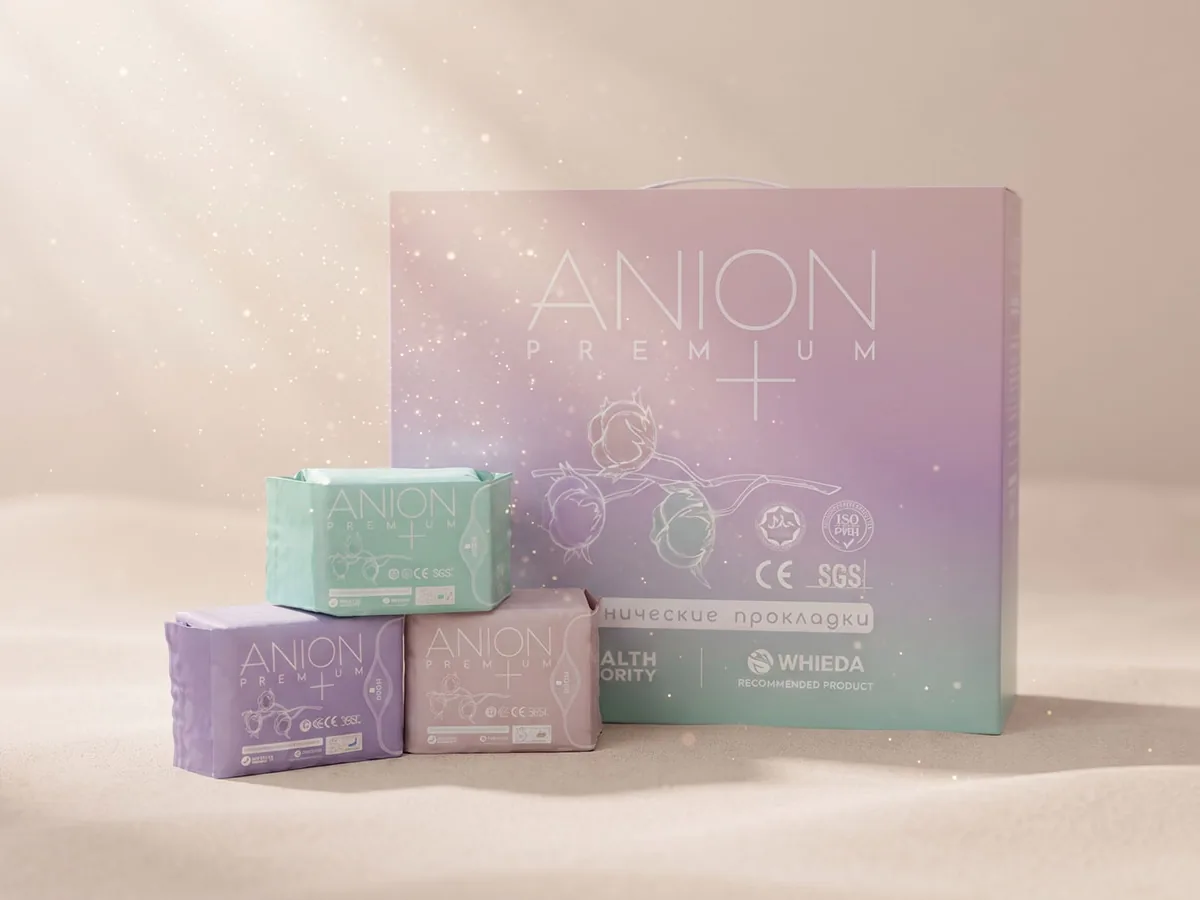
Box · D003-00
For heavy days: day and night pads, each individually wrapped; the box can be closed again after opening.
Product page →
Daily liners · D004-00
For ordinary days — for travel, for work, at the end of the cycle. The same chip; the pack opens and closes many times.
Product page →
Anion pads — are they harmful?
They have passed a sanitary inspection: the state registration certificates confirm compliance with the requirements for skin irritation, allergenicity, formaldehyde and microbes. If the skin still reacts, set the pad aside.
What do gynecologists say about anion pads?
About them specifically, we found nothing public signed by a doctor. The general rules for any pads from gynecologists are simple: a natural top layer, no fragrances, frequent changes.
Anion pads — what are they?
A multi-layer hygiene pad with a chip that, according to the manufacturer, releases negative ions from body heat. There is no publicly available measurement protocol for the pad itself.
What are anion pads for?
The box — for the days of the cycle, the daily liners — for the rest. They have no therapeutic purpose.
The box's product page has both certificates, the composition as described by the manufacturer, and a button: a consultant will confirm availability and send a link to order on the official website.
This material is for information purposes and does not replace a consultation with a doctor.