
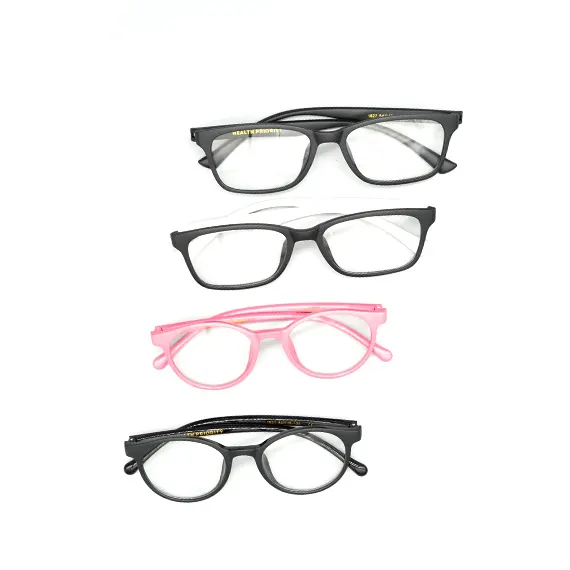
A parent posted a photo and wrote that in the mornings the child kept washing with cold water because of watery eyes and swelling. After two hours in the graphene glasses, according to the family, the swelling had almost gone by evening.
WHIEDA glasses: eye protection
How the warmth of your face turns into an anion layer
In brief
- The lenses take care of screens, glare and bright light: 380–500 nm filtering, anti-glare coating, familiar color rendering.
- PA6/G frame — graphene and tourmaline: the warmth of your face and movement turn into anions, with no batteries or wires.
- At presentations the tester shows: ordinary air 5–10 units, near the frame around 7 000, after warming up to 12 000.
- Who to show them to: a screen-filled day, a night highway, a child with a phone.
- What we didn't find: a patent for this specific frame. The measurements are a demonstration at presentations, not a laboratory protocol.
For most people, computer glasses are a clear frame with a promise of “blue light protection”. Put them on, sit at the laptop, take them off. What exactly changed is unclear. Here the main conversation is not only about the lenses, but also about the PA6/G frame.
The main point
The screen day ends. Your eyes don't.
The lenses handle the screen scenario: glare, bright light, a long stare at one point. The PA6/G frame — a graphene composite with tourmaline nano-bioceramic — is activated by the warmth of your face and micro-friction while wearing. Remove even part of the strain — and by evening you have more energy left for life.
The secret of the frame
Graphene transfers heat, tourmaline provides the charge
The materials on the graphene glasses state:
- lenses for the screen scenario with a stated filtering range of 380–500 nm;
- anti-glare coating and high lens transparency;
- a frame made of PA6/G composite — polyamide with a graphene component;
- anion activity of the frame: 1 000–2 200 ions per cm³.
The key combination is not “graphene creates a miracle by itself”. Graphene conducts heat quickly. Tourmaline responds to heat and pressure with an electric potential. Together they turn an ordinary frame into a wearable anion generator — with no batteries or wires.
Material
Graphene: the Russian trace in the material of the future
Graphene is not a separate element but a form of carbon: a single layer one atom thick, a strong hexagonal lattice. In 2004 Andre Geim and Konstantin Novoselov obtained a free-standing layer of graphene experimentally. In 2010 they received the Nobel Prize in Physics — in the committee's wording: for groundbreaking experiments regarding the two-dimensional material graphene.
In the frame it is not a “magic material” but the possibility of making a light composite with different properties from ordinary plastic: strength, conductivity and high thermal conductivity.
Frame
A light, flexible frame you won't want to take off after an hour
PA6 is polyamide-6, a strong engineering plastic. The letter G stands for the graphene component. It's a flexible frame whose material contains graphene and tourmaline nano-bioceramic — you can wear it every day rather than treating it like a laboratory sample.
If glasses press on the temples or stay in the case, all the technological sense is wasted. The temples here adapt gently to different face shapes.
The physics of wearing
How heat and movement turn into anions
The pyroelectric effect. Temperature changes — and an electric potential appears on the tourmaline crystal. Your face warms the frame, graphene transfers the heat to the tourmaline filler. The pyro- and piezoelectric response of tourmaline is a measured property of the mineral, described in a paper from Michigan Technological University.
The piezoelectric effect. Pressure and micro-friction also produce an electric potential: you move your head, adjust your glasses — microscopic changes in charge constantly arise in the material.
Graphene acts as a conductor: it quickly takes up the skin's heat and helps distribute the charge across the frame. Electrons bind with oxygen and moisture molecules around the face, forming negatively charged air ions.
Historical context
From the Chizhevsky chandelier to a technology worn on the face
The Chizhevsky chandelier worked with the air of a room and an electric discharge. The frame works at the face, with no separate power source, from a person's heat and movement. Air ionization was studied in the USSR as early as the first half of the 20th century; 1960 saw the publication of A. L. Chizhevsky's book “Aeroionification in the National Economy” — it is in the catalogue of the Russian State Library.
The comparison isn't there for effect. It helps you understand: we're not talking about “graphene magic” but about an old physical phenomenon that is now being moved from a standalone device into a wearable material.
Measurements
Put the glasses on — and the meter showed the difference
At presentations a KY-5010PRO negative ion concentration tester is used. The measurement is taken indoors, right up against the frame, at the same distance — in different seasons, across dozens and hundreds of measurements.
- ordinary air: approximately 5–10 arbitrary units;
- near the frame: around 7 000 arbitrary units;
- after skin contact and warming: up to 12 000 arbitrary units.
The glasses go on, the meter is held to the temple — and the number changes before your eyes. This isn't an argument about pretty words but an observable effect at presentations.
Lenses
Screen, headlights, bright light — without a yellow world before your eyes
The 400–500 nm range is usually called short-wavelength visible, or “blue”, light — that is how it is defined by the International Commission on Illumination (CIE). The 380–400 nm section lies at the boundary between visible violet light and UVA. The glasses' materials state filtering of 380–500 nm — the part of the spectrum that is especially noticeable during long work with LED screens and bright artificial light.
Anti-glare inorganic coating, high light transmission and familiar colour rendering — that's what the model's specification says. The point is not to dull the picture but to make it easier on the eyes for long work.
Driving
The night highway: when the eyes tire before the driver does
Night, oncoming headlights, the dashboard, the mirror, wet asphalt. In the archive of partner stories, taxi drivers describe that after long night drives in the glasses they less often had the feeling that their eyes were “popping out of their head”.
Team archive
When glasses become part of the family medicine cabinet
This is not a rehash of advertising slogans but an archive of specific observations: people named their symptoms and described what changed after the glasses became part of their everyday day.
Anastasia told us about a child who had lived with a chronic runny nose and snoring for three years. After the first day in the glasses she noticed free nasal breathing and calm sleep.
The team's materials hold the story of a man who for decades met the season with pills and tissues. After wearing the glasses daily, he described his first spring without the usual sniffles and tears.
With increasing swelling, weakness or difficulty breathing, urgent medical help is needed. Personal stories do not replace diagnosis and treatment.
Who to show them to
Who it makes sense to show these glasses to
- someone who rubs their eyes by evening and squints even at ordinary light
- someone who can't cut down their screen time: IT, sales, studying, accounting, design, working with documents
- a driver, especially on night or long-distance trips
- a parent looking for a separate pair for their child for the phone and computer
- someone who needs clear everyday glasses, not a yellow filter and not a bulky gadget
If you need dioptres, you need separate vision correction from an ophthalmologist.
Verifiable basis
What this text rests on — and where the line is
Graphene, the pyro- and piezoelectric response of tourmaline, the short-wavelength visible spectrum and air ionization are verifiable things with public sources. The links below lead to the primary sources, not to retellings.
Nobel Committee · 2010 Prize in Physics for experiments with graphene: Andre Geim and Konstantin Novoselov ↗ RSL · 1960 A. L. Chizhevsky, “Aeroionification in the National Economy” — Russian State Library catalogue record ↗ CIE · spectrum International Commission on Illumination: definition of short-wavelength visible light ↗ Michigan Tech · tourmaline Electrical properties of tourmaline: the pyro- and piezoelectric response of the mineral ↗
What we didn't find and won't pretend to. We don't have a publicly available patent for the PA6/G frame from these glasses specifically. General patents on graphene composites exist, but they aren't about this product — we won't attribute someone else's invention to it. The 2010 Nobel Prize was awarded for graphene as a material, not for glasses. The Chizhevsky chandelier is a historical bridge for understanding the phenomenon, not the same device.
The measurement figures are the team's observation at presentations with a consumer-grade tester, not a laboratory protocol with temperature and humidity control. It's an honestly presented demonstration, and that's exactly what we call it.
Product page
WHIEDA computer glasses: price, options and FAQ
The product card has a description of the lenses and frame, options for adults and children, answers to frequent questions and ordering through a partner.
Open the glasses product card →Key takeaway
Summary
You wear an ordinary light pair that makes a long day in front of the screen and on the road noticeably easier. The lenses take on the light and glare. The PA6/G frame gathers heat, movement and the mineral's properties into a continuously working anion layer at your face.
If you'd like to choose an adult or children's model, ask a question about the material or see the anion measurement, get a consultation and the official ordering link.
This material is for information purposes and does not replace a consultation with a doctor or ophthalmologist.
Published: 7 August 2026.