
≈ 3230 BC
Ötzi, the man from the Alpine glacier, walks through the snow in shoes with soles of bearskin. Inside is soft grass, wrapped around the foot like a sock. (Wikipedia)
A golden support with magnets and tourmaline: the story of one pair in numbers, patents and ancient books
In brief
WHIEDA Anion Insoles are golden half-insoles from the Health Priority brand, with neodymium magnets and tourmaline powder in the base. You slip them into the ordinary shoes you spend all day in. A shift behind the counter, changes on the metro, the shops, the stairs up home. By seven in the evening your feet are usually humming and begging to get out of those shoes. Women who bought these insoles write something different: in the evening their feet feel light. Where does that difference come from? A patent, certificates and one very old Chinese book tell the story.
Here’s how the American Podiatric Medical Association counts it. A person takes 8 to 10 thousand steps a day. Over a lifetime that adds up to about 115 thousand miles, or 185 thousand kilometres. That’s more than four times around the equator (HealthDay, citing the APMA).
And every step is a push-off. Swedish physiologists had people stand on a force platform. When walking, the foot takes one to one and a half times body weight; when running, two to three times (Nilsson and Thorstensson, 1989).
Let’s do the maths. A woman weighs 65 kg and takes 8 000 steps a day. Each step presses on her feet with at least her own weight. By evening, her two feet have taken more than 500 tonnes between them. And so it goes, every single day.
Each foot has 26 bones, 33 joints, 107 ligaments and 19 muscles and tendons. Two feet make 52 of the body’s 206 bones, a quarter of the entire skeleton.
WHIEDA opens its official description of the insoles with this phrase (product card). Physiologists have good grounds for it. In 1983 the English doctors Gardner and Fox described the venous foot pump. When you step onto your heel and the balls of your feet, the veins of the sole are squeezed and the blood moves up the leg (1983 article). Every step gives the heart a little help.
Chinese medicine has valued the middle of the foot since ancient times. The treatise Lingshu records: 腎出於湧泉,湧泉者,足心也, “the kidneys emerge at the Gushing Spring; the Gushing Spring is the centre of the foot” (text of the treatise). Yongquan, the “Gushing Spring”, is the first point of the kidney meridian. It lies in the hollow at the front third of the sole (Wikipedia).
WHIEDA’s training materials also share a piece of Chinese folk wisdom: a person ages from the feet, just as a tree dries out from the roots. The roots are what you look after first.
≈ 3230 BC
Ötzi, the man from the Alpine glacier, walks through the snow in shoes with soles of bearskin. Inside is soft grass, wrapped around the foot like a sock. (Wikipedia)
1904
Medical student William Scholl works evenings in a shoe shop. He patents an arch support and founds the Dr. Scholl’s brand. All his life he carries a foot skeleton in his pocket and invents more than a thousand foot-care products. His motto: early to bed, early to rise, work like hell and advertise. (Wikipedia)
1913
American ear, nose and throat doctor William Fitzgerald brings “zone therapy” to the United States. In the 1930s and 40s nurse Eunice Ingham maps the whole body onto the foot and names the method reflexology. (Wikipedia)
1970
Swiss priest Josef Eugster arrives in Taiwan. He is plagued by joint pain. He takes up foot massage, creates his own method, and his books spread across Taiwan, Hong Kong and mainland China. And so foot massage came back to its homeland by way of a Swiss. (Wikipedia)
2025
Rospatent registers the “Corrective Insole” under number 232093.
An ordinary insole makes a shoe softer. An anion insole turns it into a support. Pick up the pair: it’s rigid and smooth. Raised relief rises under the arch, the heel sits in a cup with raised edges, and the toes stay free.
MaterialFoam or felt
FormatFlat, one thickness throughout
After six monthsGets squashed flat
UnderfootSoft layer
DocumentsReceipt
MaterialRigid base, extra-strong alloy
FormatMiddle higher than the toe, heel in a cup
After six monthsHolds its shape
UnderfootMassage points under the arch and heel
InsideNeodymium magnets and tourmaline
DocumentsRussian patent and three certificates
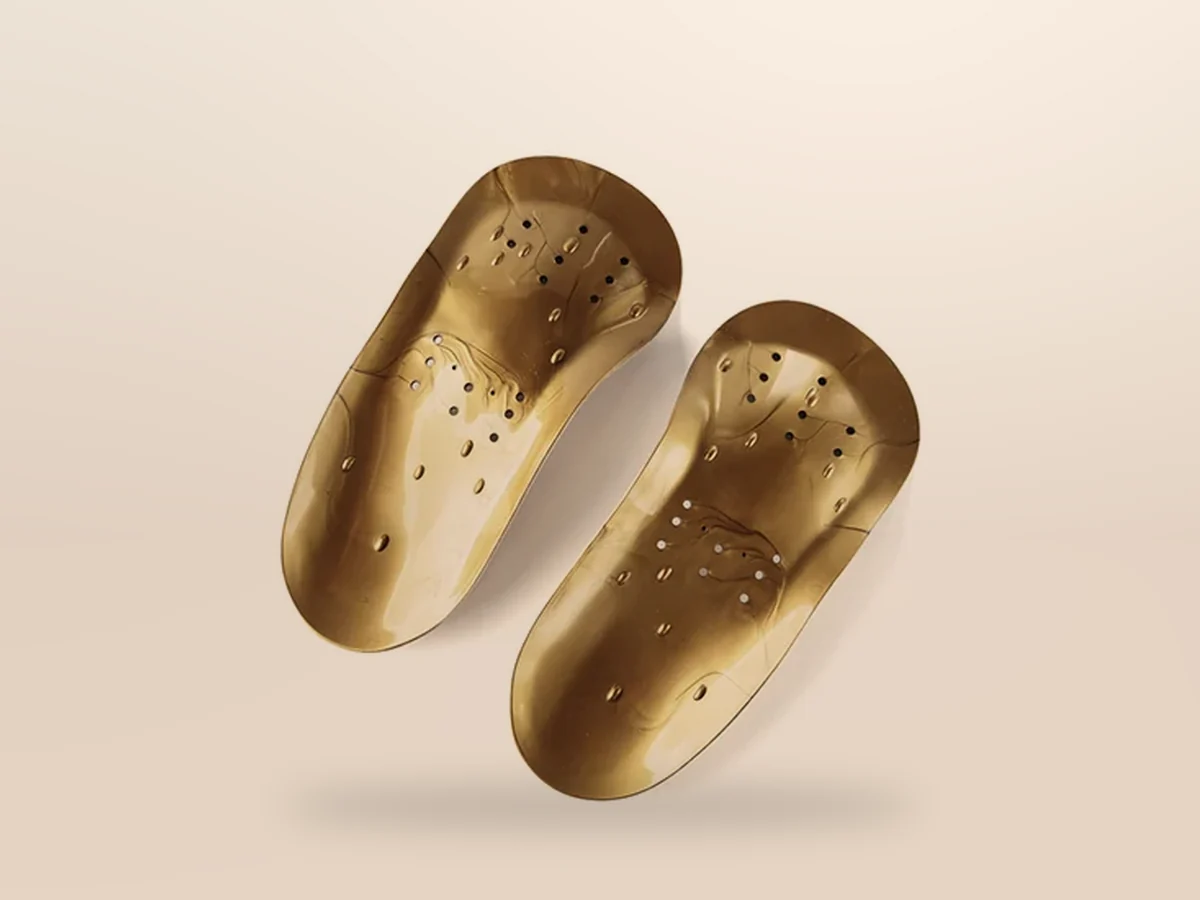
Rospatent registered Russian utility model patent № 232093 on 24 February 2025. It remains in force until 17 December 2034 (Patent PDF). The author is Liu Ting, president of the Health Priority group of companies, whose brand is on the box. The patent is held by the Moscow company Garmoniya LLC, which he heads. When checking novelty, the examiners compared the insole with Chinese models from 2014–2020 and a Soviet invention from 1993.
What the patent claims set out:
Toe and arch
The middle is raised above the toe, and the transition is an arc with a radius of 24.5–34.5 mm.
Two arch zones
The middle part is divided into two zones with raised edges; the lower one flows smoothly into the upper.
Heel
Sits lower than the middle, in a cup with raised edges, and meets it at an obtuse angle.
Massage points
In the middle and rear sections. Each is 4–6 mm long, 2–3 mm wide and 0.1 to 1.1 mm high.
Underneath
Seven quadrilateral recesses: four under the front section, three closer to the heel. They have through-holes and neodymium magnets.
Base
Tourmaline powder is added to the base material.
That’s what the insoles are called in WHIEDA’s documents. It reads “gu zheng ji”: “bone”, “straight”, “foundation”. The foundation of straight bones.
A new pair is golden. Over time, for some people it darkens, for others it gets spots, and for some it stays golden. In the manufacturer’s description the colours are read like this: whatever the colour, that organ is asking for attention. White — lungs, black — kidneys, green — liver, red — heart, yellow — spleen. The changes are individual and do not happen to everyone (the manufacturer’s description of the insoles).
This list is older than any insole. The Huangdi Neijing, the “Inner Classic of the Yellow Emperor”, has been the foundational book of Chinese medicine for more than two thousand years (Wikipedia). Its first part, the Suwen, contains this line: 白當肺,赤當心,青當肝,黃當脾,黑當腎. “White to the lungs, red to the heart, green to the liver, yellow to the spleen, black to the kidneys” (text of the treatise). Five pairs, not a single mismatch. The character 青 means the colour of young leaves, somewhere between blue and green.
The same chapter says 腎之合骨也: the kidneys are connected to the bones. And also 黑當骨: black to the bones. In Chinese medicine, the kidneys, the bones and the support underfoot form a single line. The name “foundation of straight bones” fits right into it.
Behind each colour stands one of the five elements of Chinese philosophy (Wikipedia):
Metal
White: the lungs.
Water
Black: the kidneys.
Wood
Green: the liver.
Fire
Red: the heart.
Earth
Yellow: the spleen.
We also have our editor’s story about red marks on their own pair.
The magnets in the insoles are neodymium. These are the strongest permanent magnets on sale today. They were invented in 1984 in two places at once: at General Motors in the US and at Sumitomo Special Metals in Japan, where Masato Sagawa worked (Wikipedia).
In Chinese, tourmaline is 電氣石, the “stone of electricity”: a heated crystal produces a charge (Wikipedia). WHIEDA names three forces in the insoles: far-infrared warmth, a magnetic field and anions. The warmth of your foot and your step are all they need. Nothing to charge, nothing to switch on.
A study of a textured insole, not of WHIEDA insoles. In France, 19 people aged 62 to 80 and 19 young people stood or walked for five minutes in sandals with spiked insoles. Afterwards, balance in quiet standing improved in both groups (Palluel et al., 2008). The sole feels the relief, and the body stands more steadily.
On your feet all shift
Shop assistant, hairdresser, teacher, nurse. By evening your feet are begging to get out of your shoes, and there are still three hours left on the shift.
A city on foot
The metro, changes, shops, stairs. Ten thousand steps add up all by themselves.
A day that runs till midnight
Studies, work, the commute, and you need enough energy for all of it.
A gift for parents
For a mum or dad who walks a lot and rarely complains.
“I work 14 hours on my feet. I used to not feel my feet by the end of the day. With the insoles I don’t get tired, my feet feel light.” Zhargalma from Zagustai is 18: she studies in Irkutsk and works from the afternoon until midnight. She put on the insoles and realised she wasn’t getting tired at all. A man whose feet tired quickly when walking writes briefly: “I walk longer, and I enjoy it.” Another customer has worn her pair since January: “Now I walk easily and with pleasure.” More stories on the reviews page.
Heel to heel
The heel of the insole should line up with the heel of your foot.
Shoes that fit
Everyday, work or sports shoes, neither tight nor too big.
No high heels
The design is made for an even stride.
The first month
Your foot is learning to stand on the relief. If the sensations are too strong, take a break for a day or two and then come back to them.
Every day
The insoles give more when you wear them regularly, not just on special occasions.
Do not use over open wounds or with marked skin irritation on the feet. With serious orthopaedic conditions, insoles are chosen together with a specialist. The insoles contain neodymium magnets: do not wear them if you have a pacemaker or another implanted electronic device.
№ 232093Design patent
Utility model “Corrective Insole”: base geometry, massage points, magnets and tourmaline. Open patent ↗
РОСС RU.33039.ИЛ05ОС.00516Certificate of conformity
“Shoe insoles, HEALTH PRIORITY marking”, from 3 June 2025 to 2 June 2028. Issued under the NOVA voluntary certification system, listed in the Rosstandart register, on the basis of a test report. Open PDF ↗
РОСС RU.33039.ИЛ05ОС.001058Second certificate
From 22 August 2025 to 21 August 2028. The HS code in it is 9021 10 100 0, which the customs classification lists under “orthopaedic appliances”. Open PDF ↗
CESTC2304812European check
In April 2023 a laboratory tested a sample under the EU REACH regulation for 233 substances of very high concern. Open PDF ↗
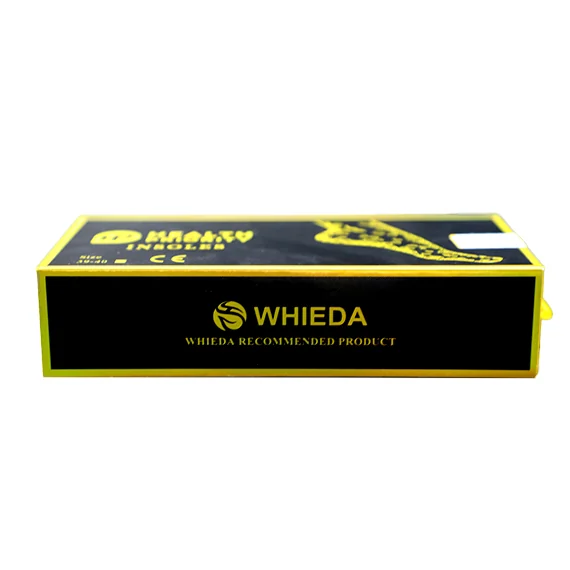
Who’s who: the insoles are made by the Tianjin Fohoway Technology Development plant in Tianjin. The box carries the Health Priority brand. In Russia and the CIS they are sold by WHIEDA.
When will I feel the difference?
For the first few days the relief feels unfamiliar: your foot is standing on a support it isn’t used to. Customers write about light feet in the evenings. According to WHIEDA, the unfamiliar feeling is strongest in the first month, and in 95% of cases it passes or noticeably eases by the third.
Why are the insoles shorter than the shoe?
They’re half-insoles: from the heel to the balls of the feet. The toes stay free and work with every step.
What sizes are there?
Six: 35–36, 37–38, 39–40, 41–42, 43–44 and 45–46. Size 45–46 is a separate item in the catalogue.
How long do they last?
The base is made of an extra-strong alloy, and WHIEDA says it plainly: the insoles will last a long time. The rigid shape doesn’t get squashed flat the way foam does.
A patent with geometry precise to fractions of a millimetre, neodymium magnets, tourmaline and the five colours of an ancient book, all in one golden pair.
A pair costs 11 000 ₽, about 30 ₽ a day over just the first year of wear. Size 45–46 is 11 500 ₽. You can check on the product card whether your size is in stock.