Fohow Lingzhi Capsules: a mushroom 6,800 years old
From the shamans of Hemudu to Emperor Qianlong’s golden sceptres — the story of the lingzhi mushroom told through finds, decrees, legends and one capsule
Prepared by the WWC editorial team · fact-checked on 13 October 2026
6,800 years
In brief
The oldest lingzhi ever found is 6,817 years old. It lay in an excavation pit beside shamans’ ritual objects.
For this mushroom an emperor pardoned the whole country, and for Qianlong’s jubilee about 50 kg of gold went into sceptres shaped like it.
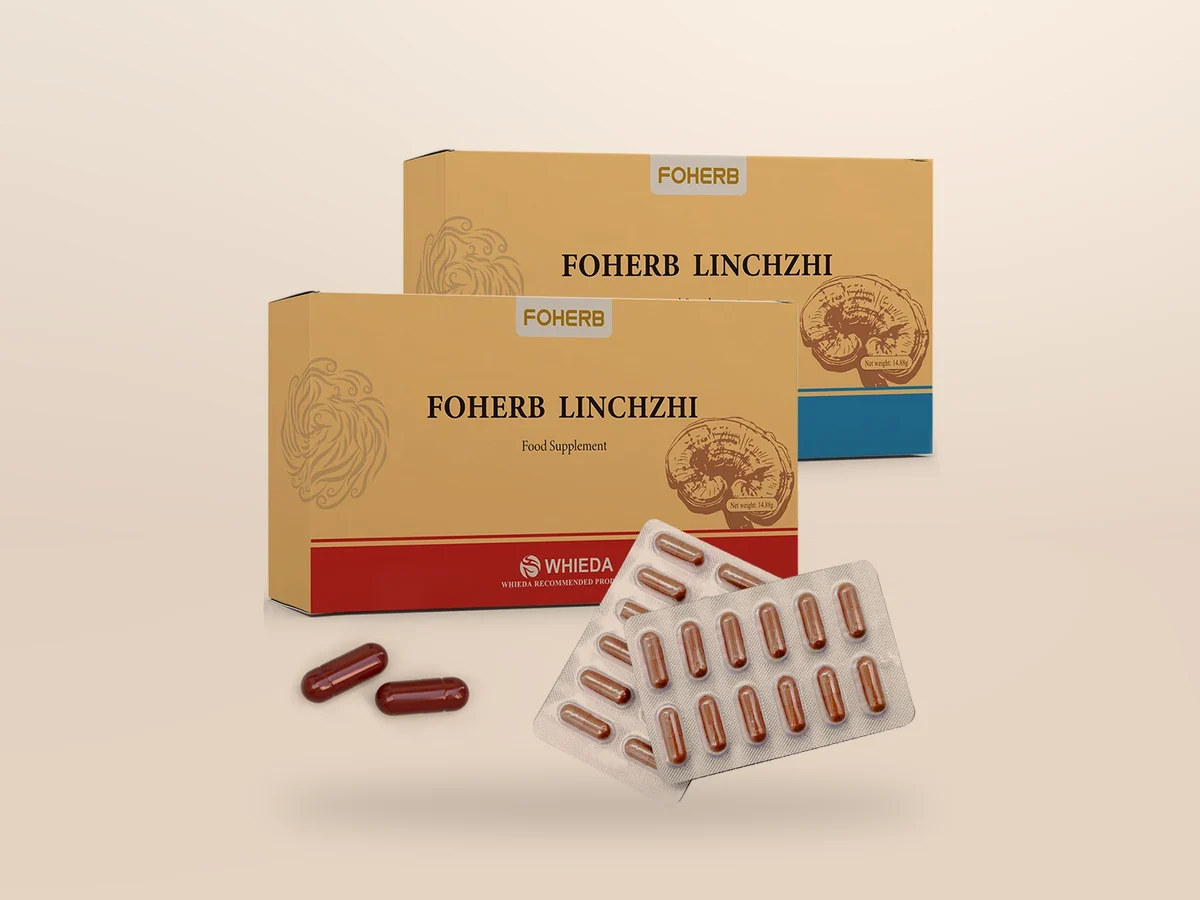
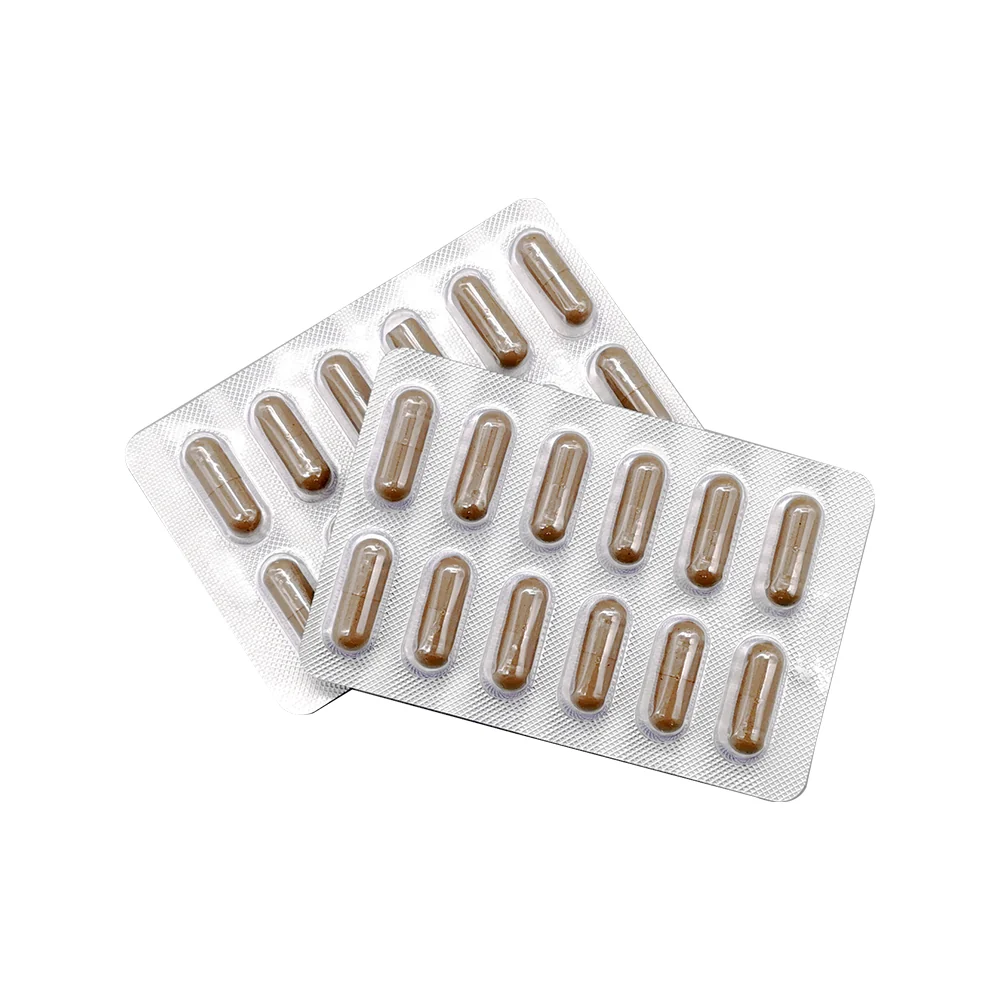
Inside each capsule: lingzhi spores with cracked shells, lingzhi mycelium, American ginseng and cordyceps.
Take one capsule twice a day with meals; a course lasts two weeks.
Fohow Lingzhi Capsules bring together the lingzhi mushroom, American ginseng and cordyceps. They are made at the Fohow pharmaceutical plant in Tianjin and brought to Russia by WHIEDA. Archaeologists trace this mushroom’s story back 6,800 years. Then came imperial decrees, gold, and Taoists in search of immortality. Today the same mushroom fits into a half-gram capsule, its spores cracked open right at the factory.
Zhejiang · 6,800 years ago
A mushroom from the shamans’ dig
The Tianluoshan dig in Zhejiang province is a settlement of the Hemudu culture. In 2018 Chinese archaeologists described a real mushroom of the genus Ganoderma — that is, lingzhi — found there. Radiocarbon dating put its age at 6,817 ± 44 years. Shamans’ ritual objects lay beside it. That is why the authors believe lingzhi was already in use back then (Chinese Science Bulletin, 2018).
In total the scientists studied five specimens from three sites. The other two mushrooms are younger: 5,379 and 4,508 years old. The work pushed the history of lingzhi two thousand years further back than Shennong — the mythical farmer-emperor to whom China credits its first book of herbs.
6,817 ± 44 years
The age of the Tianluoshan lingzhi. The Great Pyramid of Giza is about 4,600 years old (Wikipedia), so the mushroom is more than two thousand years older.
Shennong was even painted with this mushroom. In a Liao-dynasty mural inside the wooden pagoda of Fogong Temple, he walks through the mountains with a basket of herbs on his back. In his right hand he holds a lingzhi.
Shennong’s book, the Shennong Bencao Jing, lists no fewer than six lingzhi: blue, red, yellow, white, black and purple. All six sit in the highest class. Of the red one it says 增智慧,不忘 — “adds wisdom and keeps you from forgetting.” Of the purple one: 好顏色 — “gives a good complexion” (text of the herbal). Red and purple are the only two lingzhi included in the Pharmacopoeia of the People’s Republic of China (a leaflet from the Beijing Medical Products Administration).
祥云
The authors of the Tianluoshan paper see lingzhi as the prototype of the “auspicious cloud” motif. That very motif covers the Beijing 2008 Olympic torch, which is even called Lucky Cloud (Wikipedia).
Timeline
The imperial mushroom: a decree, sceptres and a ruinous stone
For two thousand years, a lingzhi at court was read as a sign of Heaven’s approval. Here is how it was honoured.
109 BC
At the Ganquan Palace of Emperor Wu of Han, a lingzhi grew with nine stems and fused leaves. The emperor issued a decree: an amnesty for all Under Heaven. The district was granted oxen and wine, and Wu himself composed the “Song of the Lingzhi Chambers.” (Book of Han)
Around 317 AD
In his book Baopuzi, the Taoist Ge Hong ranked the medicines of the immortals. First came cinnabar, second gold, third silver — and right after them, all the lingzhi. There are five classes of them, with about a hundred kinds in each. Stone lingzhi glows in the dark and can be seen from 300 paces away. Only someone who has fasted and carries Lao Tzu’s talisman can find it. (Baopuzi)
Late Ming dynasty
The official and calligrapher Mi Wanzhong found an eight-metre boulder. He built a road to it and flooded the route with water so the stone could be dragged over the ice in winter. The money ran out before the road did. The stone was abandoned and nicknamed “the stone that ruined the family.” (Zhongxin)
Qing dynasty
More than a hundred years later, Emperor Qianlong found the stone. He had the boulder taken to the Summer Palace and named it “Green Lingzhi Peak” for its likeness to the mushroom. The stone still stands in the courtyard of the Hall of Happiness and Longevity. (Visit Beijing)
Qianlong’s jubilee
The head of a ruyi sceptre — the name means “as you wish” — echoes the shape of a lingzhi, so under the Qing ruyi were given as wishes for long life. For Qianlong’s 60th birthday, his officials collected 1,361 liang of gold and made 60 ruyi sceptres. (Guangming Daily via Xinhua)
Today
The Palace Museum, the former Forbidden City, holds more than 2,000 ruyi sceptres from the Ming and Qing dynasties. (China Daily)
≈50.8 kg
That is what 1,361 liang of jubilee gold weighed: a Qing liang was 37.3 grams.
≈$6.8 million
What that gold is worth today, at the price of 8 October 2026: $134,335 per kilogram (quote).
The twist
Treasure in the spores: what has changed in 6,800 years
For twenty centuries lingzhi was hunted in forests and awaited like an omen. Since the early 1970s it has been cultivated. The Beijing leaflet says it plainly: today lingzhi is mostly farmed, and its price is no longer fit for an emperor. So where is the treasure now? In the spores.
A spore is the tiny grain a mushroom uses to reproduce. It is 7–8 microns long — about ten times thinner than a human hair. Its shell is double-layered and tough, and through such a wall the spore’s contents are poorly absorbed, the same leaflet explains. That is why China came up with 破壁 — “breaking the wall.”
In Fohow capsules the spores arrive already cracked open: the shell is broken during production (official description).
Whole spore
Size7–8 microns
ShellDouble and tough
ContentsLocked behind the wall
Polysaccharides extracted in the labBaseline
Spore in the capsule
SizeThe same 7–8 microns
ShellBroken at the factory
ContentsOpen
Polysaccharides extracted in the lab1.7 times more
The share of spore shells broken, according to the official capsule description.
Composition
Three treasures in one capsule
Four raw ingredients and three stories inside.
Lingzhi spores
The very ones cracked open at the factory.
Lingzhi mycelium
The mycelium from which the mushroom itself grows. It adds polysaccharides and triterpenes to the spores.
American ginseng
A root extract that once opened up trade between two countries. The story is below.
Cordyceps
Mycelium of Chinese cordyceps — a fungus of the Tibetan mountains that in 2012 cost twice as much as gold at retail. We told its story in our article about the Phoenix Elixir.
American ginseng was found thanks to a Chinese picture. In 1716 the Jesuit Joseph-François Lafitau was serving as a missionary near Montreal. He showed the Iroquois a drawing of Chinese ginseng, and they led him to a related plant. The Iroquois themselves called the root “the one that looks like a man.” In China it is called 花旗参 — “flowery-flag ginseng,” meaning American (Wikipedia).
30 tonnes
On 22 February 1784 the first American merchant ship to China — the Empress of China — sailed from New York. Her hold carried about 30 tonnes of American ginseng. Six months later in Canton it was traded for tea and porcelain (Oxford University Press).
On 17 November 2023, China’s National Health Commission and State Administration for Market Regulation added nine herbs to the “both food and medicine” list. It includes two heroes of this capsule at once — lingzhi and American ginseng. For lingzhi, the list takes the fruiting body of the red and purple species and sets strict limits on lead, cadmium, arsenic and mercury (NutraIngredients).
Legends
Shennong’s daughter and the White Snake
In Chinese the mushroom is written 灵芝: 灵 means spirit, wondrous power. It is also called “the herb of the immortals” and “the divine mushroom.” Behind every name there is a tale.
The Classic of Mountains and Seas, a book from the 4th–1st centuries BC, tells how an emperor’s daughter died on Mount Guyao and turned into a herb. “Whoever eats it will be loved by people” (text). Legend names her Yaoji, the third daughter of Yandi, who is identified with Shennong. The maiden’s soul became lingzhi, and she herself became the goddess of Mount Wushan. Her Goddess Peak still stands among the twelve peaks of Wushan above the Yangtze (Wikipedia).
In the Legend of the White Snake, Bai Suzhen drinks realgar wine at the Duanwu festival and takes on her serpent form. Her husband, Xu Xian, dies of fright. So she flies to Mount Kunlun, battles the boy guardians and brings back a lingzhi. The episode “Stealing the Immortal Herb” is staged as a separate Peking opera performance; in 2026 it was put on in Zhejiang (announcement).
Research
What studies of lingzhi and ginseng have shown
Science takes lingzhi seriously. In 2012 Chinese scientists sequenced its entire genome — 16,113 genes — and called the mushroom a “model medicinal fungus” (Nature Communications). Here are three studies of the raw ingredients that go into the capsule.
90 studies
A study of the ingredient, not the finished product. A 2023 systematic review brought together 90 studies on lingzhi spores. Its conclusion on technology is clear: extract from shell-broken spores worked more effectively than extract from whole ones (Cureus, 2023).
−28,3%
A study of the ingredient, not the finished product. A double-blind trial included 132 people whose main complaint was feeling run-down. For eight weeks some took lingzhi polysaccharide extract and others a placebo. Fatigue fell by 28.3% in the lingzhi group and by 20.1% in the placebo group. A noticeable improvement was reported by 51.6% versus 24.6% (J Med Food, 2005).
3 hours
A study of the ingredient, not the finished product. 52 healthy people aged 40 to 60 took a single dose — 200 mg of American ginseng extract — or a placebo. Three hours later, working memory was better in the ginseng group, and blood sugar did not change (Human Psychopharmacology, 2015).
Who it’s for
Who will especially love these capsules
In China, people reach for lingzhi when they need two things at once: a clear head and calm sleep. Tradition puts it briefly — it replenishes Qi and calms the spirit.
Your mind by evening
By four o’clock your to-do list blurs, and the name you need is right on the tip of your tongue.
Sleep
You fall asleep late, then wake at three in the morning thinking about tomorrow.
After an illness
The cold passed two weeks ago, but your strength never quite came back.
A month at full stretch
A quarterly report, your son’s exams and a renovation — all at once.
Ritual
How to take Fohow Lingzhi Capsules
The ritual takes ten seconds. No brewing, no measuring, no bitter taste to put up with. The regimen comes from the state registration certificate:
One capsule
Twice a day, with meals.
A sip of water
Wash the capsule down with a little water.
Two weeks
A course is 14 days, which is 28 capsules.
Two packs
Each pack holds 24 capsules; the course needs a second one, which will still have 20 left over.
Zhanara A. wrote after a month of taking them: “I fall asleep and wake up easily, I have strength and energy.” More stories on reviews page.
Taste
Lingzhi itself is bitter — Shennong wrote exactly that: 味苦. The capsule is swallowed whole, so you won’t taste any bitterness.
Storage
Shelf life is 24 months. Keep the pack in a dry place, out of direct sunlight, at up to +25 °C and out of the reach of children.
Contraindications from the state registration certificate
Individual intolerance to the ingredients, pregnancy, breastfeeding. Consult a doctor before use. Recommendations are for adults. The capsule shell is gelatin.
EAEU certificate dated 6 April 2021. It lists the capsules as a source of beta-glucans, the polysaccharides of the mushroom’s cell wall. Manufacturer: Fohow (Tianjin) Pharmaceutical. Open PDF ↗
CN216228737UThe plant’s capsule line
A device that polishes and sorts capsules: brushes spin them along a spiral while dust is vacuumed away. Application filed on 18 November 2021. Open patent ↗
CN120505391ALingzhi and codonopsis
In a 2025 application, the plant grows lingzhi mycelium together with codonopsis root cells. Open the application ↗
100+Over a hundred patents
Inventions, utility models and industrial designs of the group’s companies. List on Google Patents ↗
GR202312000548High-tech enterprise
Certificate dated 6 November 2023, issued by Tianjin’s science, finance and tax authorities. Certificate scan ↗
WEF · 2023“Innovation” award
The World Economic Forum’s New Champions Awards in the “Innovation” category. It went to the FOHERB group, which includes the Fohow plant. WEF page ↗
Fohow is the pharmaceutical plant in Tianjin that makes the capsules. FOHERB is the plant’s group and the brand on the box. WHIEDA sells the capsules in Russia and the CIS.
FAQ
Questions
Where are Fohow Lingzhi Capsules made?
At the Fohow pharmaceutical plant in Tianjin’s Baodi district. Its workshops opened in 2007 and cover 25,928 m². China’s Ministry of Commerce granted the company a direct-selling licence in 2016. The corporation’s products are sold in more than a hundred countries — figures Fohow cited in April 2026 during its visit to the Great Stone industrial park. park news ↗
How can you tell real lingzhi from a fake?
By the stem. The Beijing Medical Products Administration warns that the artist’s conk is sold as “wild lingzhi.” Lingzhi has a stem at the side and a glossy cap that looks varnished. The artist’s conk has no stem, and its cap is covered in rings and bumps. You can’t check slices or powder by eye, so the leaflet advises buying them at a pharmacy. Fohow capsules have a state registration certificate and a factory with a real address. leaflet, PDF ↗
Why does the label say “five-leaf ginseng”?
That is American ginseng. Its Latin name, Panax quinquefolius, translates as “five-leaved.”
How do the new capsules differ from the old ones?
The new formula adds lingzhi mycelium, cordyceps mycelium and American ginseng to the spores. It contains six times more lingzhi polysaccharides than the previous one, according to the official description. capsule product card ↗
Summary
The mushroom of shamans and emperors — one capsule at lunch
6,800 years ago, lingzhi lay beside ritual objects. Under the Han dynasty a whole country was pardoned for its sake; under the Qing its shape was cast in gold. Today the cracked spores of this mushroom, American ginseng and cordyceps all fit into a single capsule.
A pack of 24 capsules costs 2,000 ₽ — about 83 ₽ per capsule, or 167 ₽ a day on the regimen from the certificate. Availability and ordering are on the capsule page.