A flower bred to replace whale oil, the oil of samurai swords, “dragon’s gall” and three patents on the box — the story of one bottle in facts and legends
Prepared by the WWC editorial team · fact-checked on 13 October 2026
Seven stories
In brief
Seven ingredients, each with its own story: from a flower in Oregon to yeast discovered in bumblebee honey.
The Chinese box lists three invention patents, one for each ingredient.
The factory has passed an Intertek audit for international cosmetics GMP, and the oil has an EAEU declaration valid until 2031.
A little oil after toner and before cream: it absorbs and leaves no greasy shine.
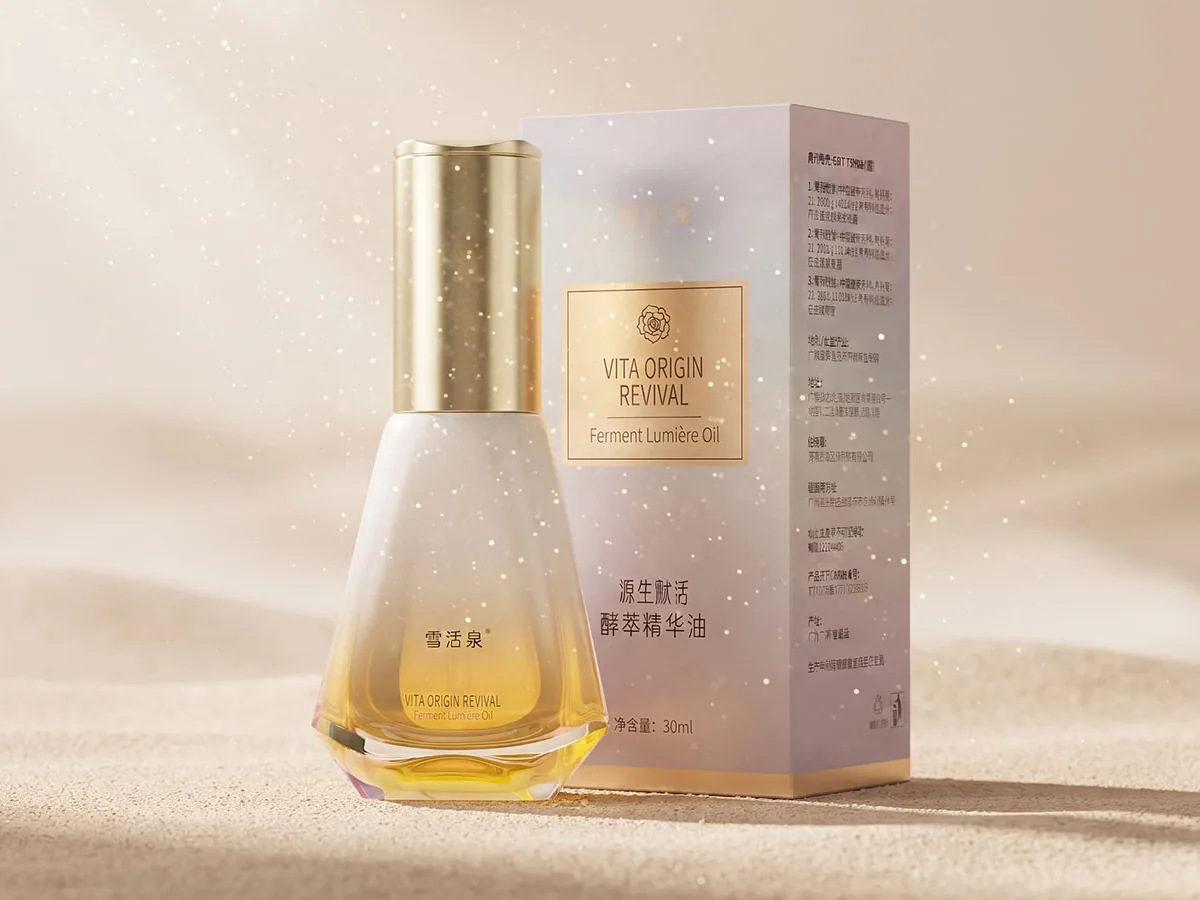
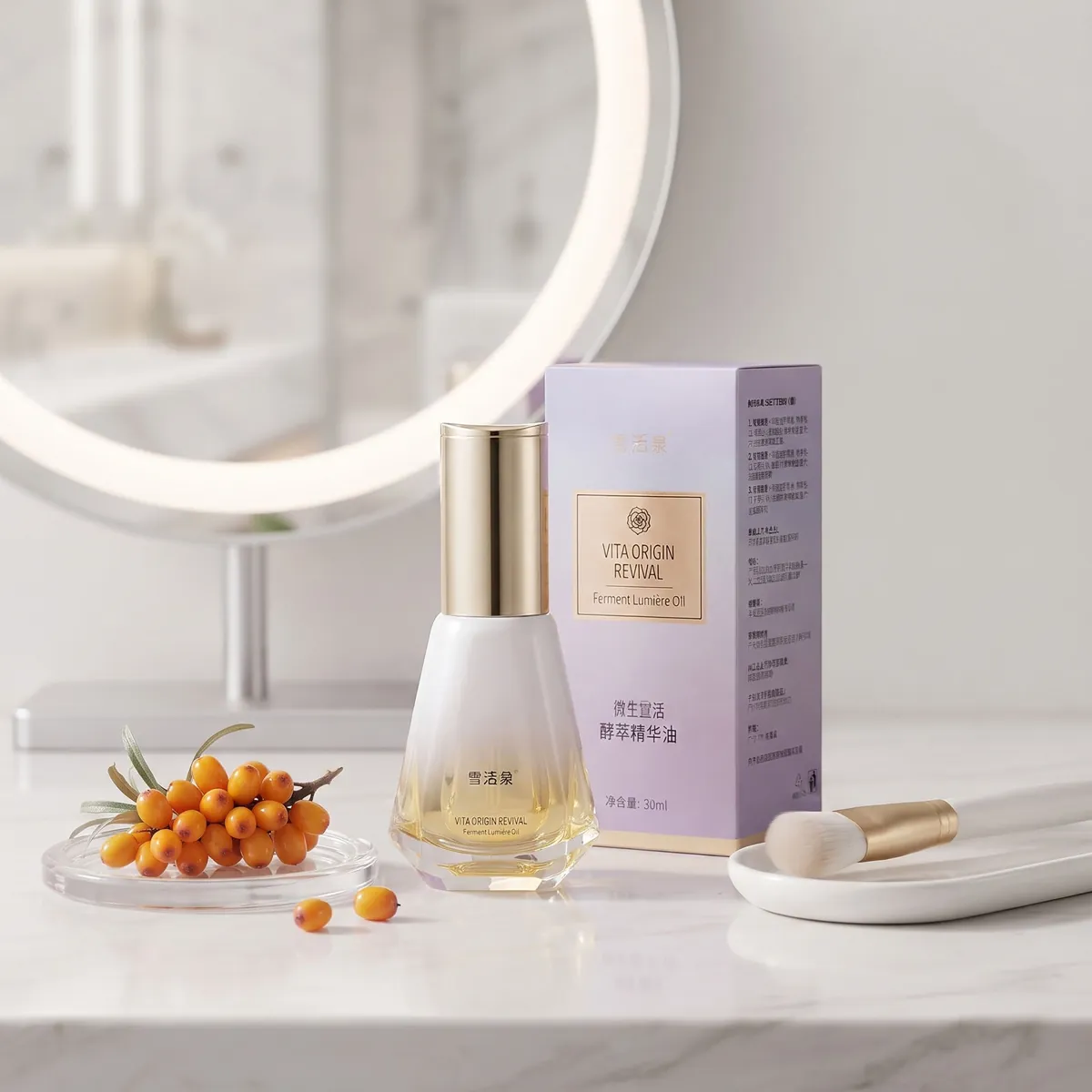
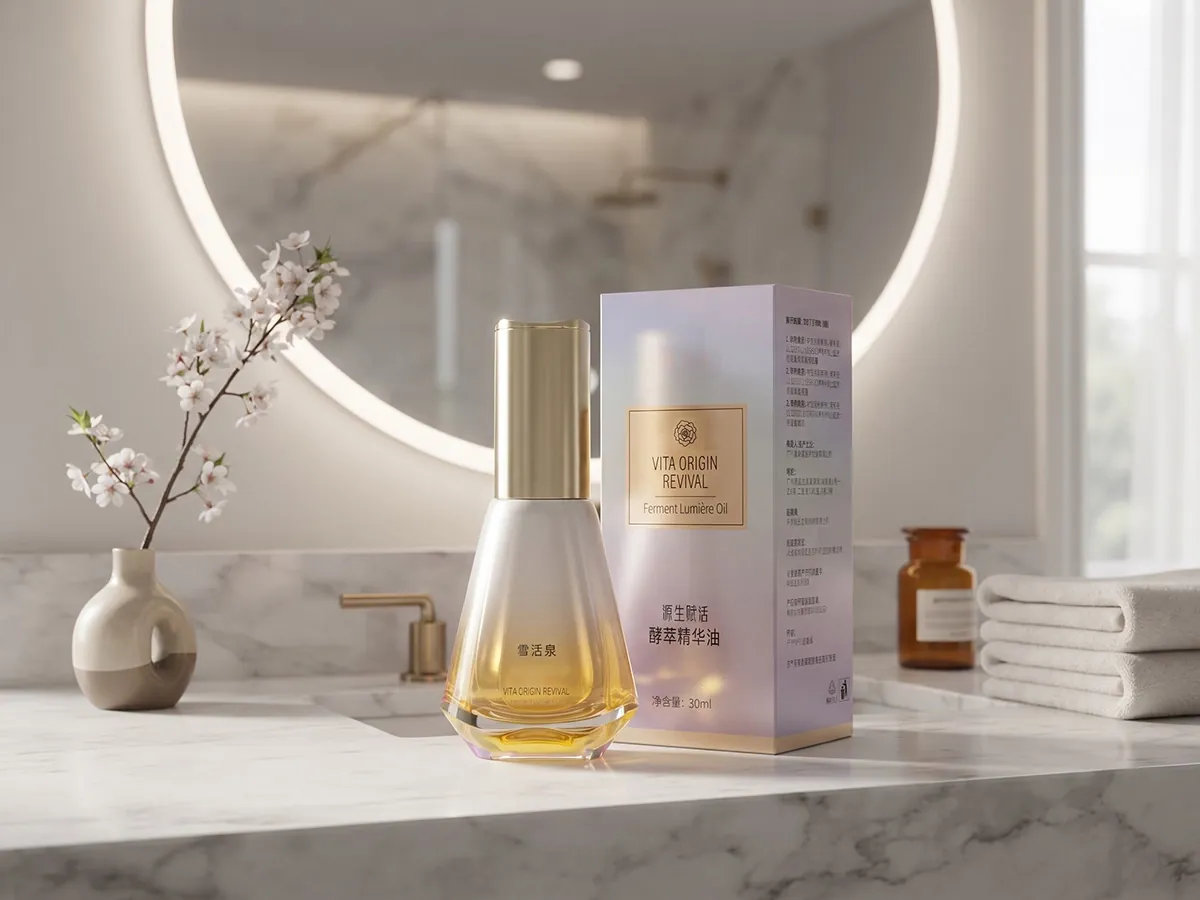
Fundesee Oil-Essence is a light facial oil from the Fundesee cosmetics line, sold in Russia by WHIEDA. It goes on after toner and before cream. The 30 ml golden bottle brings together ingredients that each have a biography of their own. One begins on the deck of a whaling ship. Others lead to Japanese swords, Chinese herbals and bumblebee honey. You can read them from the ingredient list on the box, line by line.
Meadowfoam · Oregon
The flower bred to replace whale oil
For centuries sperm whales were hunted for their oil. Sperm oil went into the finest machine lubricants, car gearboxes, medicines and cosmetics. In the 20th century the world needed a substitute, and it was found in the damp meadows of California and Oregon: a low-growing white flower, Limnanthes alba. In English, meadowfoam (Oregon State University).
1950s–1960s
The US Department of Agriculture screens thousands of wild plants by chemical analysis. In meadowfoam seeds it finds fatty acids never before seen in any plant. It is one of the first crops discovered in a laboratory rather than in old recipes.
1971
Sperm whales come under the protection of international law. Oregon State University decides to domesticate meadowfoam as a replacement for whale oil. The programme’s motto is “Thar she grows!” — a play on the whalers’ cry “Thar she blows!”, shouted from the mast on spotting a whale’s spout.
1975
The wild flower creeps along the ground and drops its seeds at once. For seven or eight generations in a row, scientists select upright plants that hold on to their harvest. And so the first variety is born: Foamore.
Late 1970s
The petrochemical industry finds a cheaper substitute for lubricants. But the Japanese cosmetics industry takes an interest in the oil, and meadowfoam moves into skin and hair care.
98%
The share of long-chain fatty acids in meadowfoam oil. That makes it one of the most stable plant oils, and cosmetic chemists love it for the softness and smoothness it gives the skin (Wikipedia).
Squalane · 1906
Squalane: named after a shark, related to your skin
In 1906 the Japanese chemist Mitsumaru Tsujimoto was studying the liver oil of a deep-sea shark and found an unfamiliar substance in it. It was named squalene, after Squalus, the Latin name for sharks (Wikipedia).
Then came the key discovery: humans make squalene too. It is secreted by the skin’s sebaceous glands.
12%
Roughly the share of squalene in human sebum. It also contains triglycerides (about 41%), wax esters (26%) and free fatty acids (16%) (Wikipedia).
Squalane is the stable form of squalene. The skin greets it like an old friend: it is a relative of what the skin produces itself. Olives have their own natural squalene too — olive oil contains 0.2–0.5%. And olive oil is the very first line in the Fundesee ingredient list.
Sea buckthorn · Hippophae
Sea buckthorn — the “shining horse”
The Latin name for sea buckthorn, Hippophae, is made of two Greek words: “horse” and “light.” The Greeks fed their horses sea buckthorn leaves to make their coats shine (Wikipedia).
−43 °C
The frost a sea buckthorn bush can withstand. Its roots hold sand in place and enrich the soil with nitrogen. In northwest China, sea buckthorn is planted along dried-up riverbeds so the land can hold water.
For us, sea buckthorn is a familiar dacha plant: orange berries in September, jam for the winter. In the Fundesee bottle, its oil meets Japanese camellia.
Japanese camellia · tsubaki
The oil of samurai swords
In Japan camellia oil is called tsubaki. For centuries it was applied to hair and skin. It was also used to protect Japanese swords and carbon-steel blades from rust, and to polish the boards and pieces for shogi, Japanese chess. The purest oil is said to come from the Goto and Izu islands (Wikipedia).
The oil once trusted with a blade behaves gently on the skin. It is prized for its light texture.
Ferments · 1954–1970
Yeast from bumblebee honey
On the Chinese box, the oil carries the word 酵萃 — “ferment extract.” The formula includes two ingredients made by living microorganisms: lactobacillus lysate and products of fermentation by the yeast Candida bombicola.
This yeast has the most summery story in the bottle. It was found in wildflower nectar in 1954, and in 1964–1967 in bumblebee honey. The name bombicola comes from Bombus, Latin for “bumblebee.” The species was described in 1970 and renamed Starmerella bombicola in 2012. The yeast produces sophorolipids — natural substances with a gentle, soap-like structure (Ghent University review, 2021).
The twist
What you’re holding
The seven stories are lines from the official ingredient list, not an advertising legend. Here it is in full, split into two parts.
What it givesThree ingredients covered by the patents
That makes five plant oils, squalane and bisabolol. The official description promises deep nourishment and hydration, smoothness and radiance from them. Fine lines become less visible.
How it works
Three patents on the box
On the side of the Chinese box are three identical lines: “Chinese invention patent,” a number and the ingredient it covers. Each of the three deserves its own story.
Pro-Xylane
This “green chemistry” molecule was created by French chemists from xylose, a wood sugar from beech. The synthesis takes place in water, using a reaction discovered by Professor André Lubineau. The molecule came to market in September 2006, twenty years ago, and became the first “green” chemical ingredient in cosmetics (Cavezza et al., 2009). In China it is called 玻色因, “boseyin.” In the oil’s description, Pro-Xylane takes care of the skin’s structure.
Gentian root extract
Rough gentian, Gentiana scabra — the very one described in Chinese herbals. In the oil it is a powerful antioxidant against stress.
Glyceryl glucoside
This sugary relative of glycerin forms all by itself when Japanese sake is brewed: glycerin and glucose combine in the fermenting rice mash (Lee et al., 2023). In the oil it holds moisture for a long time.
Culture
Dragon’s gall
In Chinese, gentian is 龍膽 — “dragon’s gall.” Where the name comes from is explained by the Bencao Gangmu, Li Shizhen’s great herbal of 1578: 葉如龍葵,味苦如膽,因以爲名 — “its leaves are like nightshade, its taste bitter as gall, hence the name” (text of the herbal). The most ancient herbal, the Shennong Bencao Jing, placed gentian in the highest class.
It blooms in the seventh moon with blue bells. The herbal paints them like this: 作鈴鐸狀,青碧色 — “shaped like a bell, the colour of azure.” A bitter root with a dragon’s name and delicate blue flowers — one and the same herb. It is the extract of this root that goes into the oil.
Research
Aquaporins: the cell’s plumbing
The membranes of skin cells contain channel proteins called aquaporins. Water and glycerin enter the cell through them. For a hundred years scientists thought water simply seeped through the membrane. The American Peter Agre found dedicated channels for it and in 2003 received the Nobel Prize in Chemistry “for the discovery of water channels” (Nobel Committee). He himself called them the plumbing system of the cell (Wikipedia).
5%
A study of the ingredient, not the finished oil. Scientists at the Hamburg company Beiersdorf applied a formula with 5% glyceryl glucoside to volunteers. Activity of the aquaporin-3 gene in the skin increased, and the skin lost less water than on areas treated with the same base without glyceryl glucoside (Schrader et al., 2012).
Who it’s for
Who will especially love this oil
The oil is made for skin that lacks moisture and softness, and for a woman who has five minutes left for herself in the evening:
Central heating
The radiators are on, and by evening your face feels tight. The cream has soaked in, yet an hour later it’s dry again.
Fine lines
Your skin has lost its smoothness, and foundation settles into the creases.
Dull tone
By Friday your face looks tired, with no glow at all.
An evening for yourself
Five minutes at the mirror, warm palms, a lovely scent — and the day is done.
Ritual
How to apply Fundesee Oil-Essence
The ritual is short; you don’t need to set aside special time for it. Everything follows the official instructions:
Cleanse your skin
Wash your face, then apply toner or essence.
Take a little oil
A small amount is enough.
Massage it in
With light massaging movements, until fully absorbed. No need to rinse off.
Seal with cream
The oil goes on before cream.
In the Fundesee line, the oil is step five of seven: after the milk, essence, serum and eye cream. In spring and summer it is sealed with an emulsion; in autumn and winter, with a lifting cream.
Important notes from the official instructions and declaration
Cosmetics for adults, for external use only. Stop use immediately in case of irritation or an allergic reaction. Store in a cool, dry, dark place out of the reach of children, at +5 to +25 °C, away from direct sunlight.
Documents
Patents and documents
3 patentsChinese invention patents
ZL 2020 1 1422445.0 — Pro-Xylane; ZL 2019 1 1114611.8 — gentian root extract; ZL 2019 1 0072965.4 — glyceryl glucoside. The numbers and ingredients are printed on the box. Photo of the box ↗
SZ2412E5GMP to ISO 22716
Intertek audited the Guangzhou factory for compliance with the international standard of good manufacturing practice for cosmetics. The first audit took place in 2021, and the certificate is valid until 15 December 2027. The certification scope notes that the factory may produce products for the skin around the eyes and cosmetics for babies and children. Certificate scan ↗
SZ2412E6GMP to FDA guidance
The second certificate from the same audit: compliance with the US Food and Drug Administration’s guidance on good manufacturing practice for cosmetics, 2022 edition. Valid until 15 December 2027. Certificate scan ↗
EAEU N RU Д-CN.РА02.В.62861/26Declaration of conformity
The oil complies with technical regulation TR CU 009/2011 “On the safety of perfumery and cosmetic products.” The declaration was registered on 17 March 2026 based on test results and is valid until 16 March 2031. Open PDF ↗
Who’s who: the oil is made at a cosmetics factory in Guangzhou, and WHIEDA sells it in Russia and the CIS.
FAQ
Questions
The colour of the oil differs from my last bottle. Is it defective?
No. The oil is made using natural fermentation, so its colour and scent may vary slightly from batch to batch. The official instructions call this normal: it does not affect how the oil works.
What does the oil smell like?
Magical — that’s what the official text calls it. It turns your daily care into a relaxation session, a little home spa.
Can I buy the oil without the set?
Yes, the 30 ml bottle is sold separately. The whole seven-step system comes together in the Fundesee gift set. gift set in the catalogue →
Which standard is the oil made to in China?
China’s national standard GB/T 29990 “Skin care oils,” type I. In Guangdong province the oil is registered as general cosmetics, with a 2025 filing. Its number, 粤G妆网备字2025158353, is printed on the box.
Summary
Seven stories — on your shelf
A flower bred to replace whale oil, a relative of your own skin’s sebum, the “shining horse,” the oil of samurai blades, “dragon’s gall,” yeast from bumblebee honey and a sugar from sake. Thirty millilitres, seven stories and three patents.
A 30 ml bottle costs 7,000 ₽. The product card shows whether it is in stock right now.