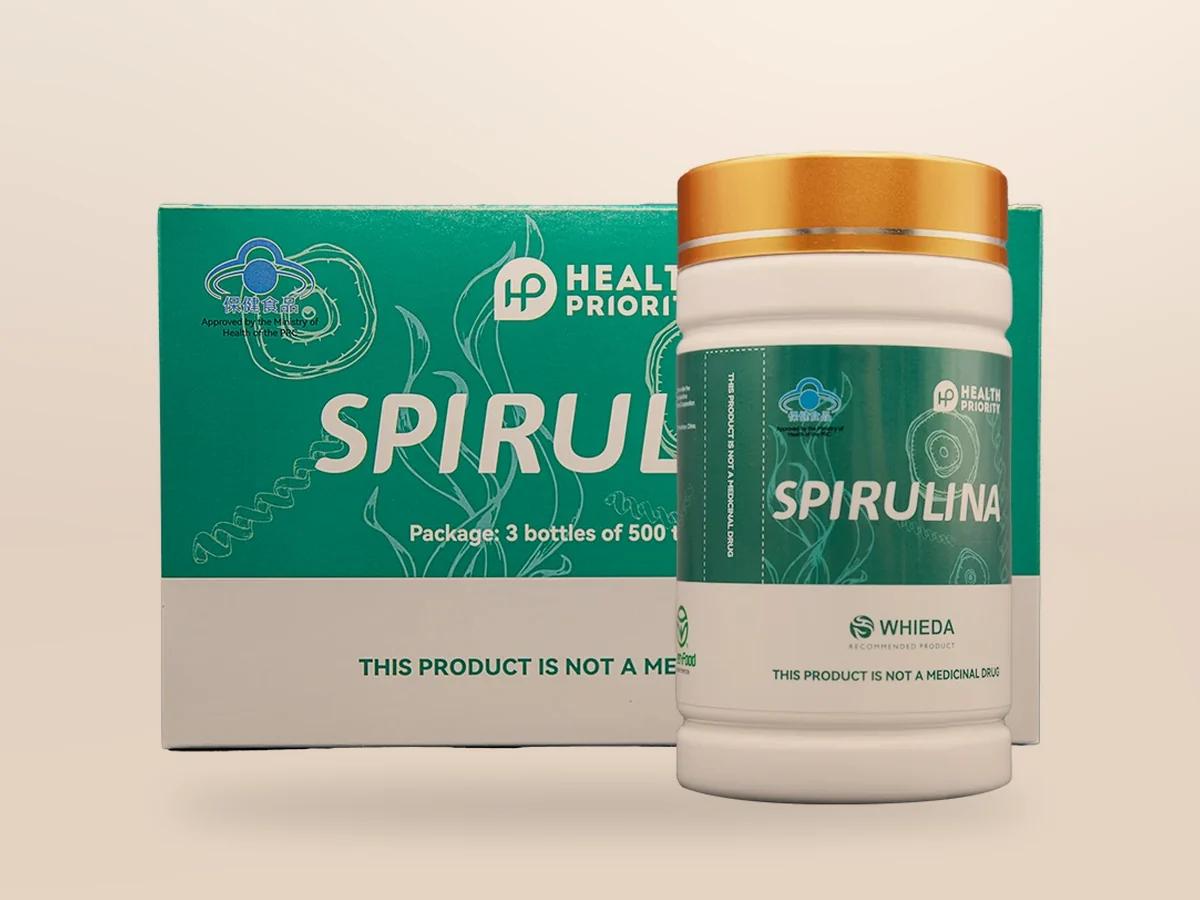
Tenochtitlan cakes, Lake Chad flatbreads, reactors on the ISS and the Wuyi mountains — the story of one green tablet
Prepared by the WWC editorial team · fact-checked on 13 October 2026
Aztec food
In brief
In 1519, little cakes made from a blue-green lake alga were sold at the main Aztec market. Historians believe it was spirulina.
NASA studied it as food for crews, and the European Space Agency grew it on the ISS.
WHIEDA tablets are made by a factory in the Wuyi mountains that produces about 15% of China’s spirulina. Its strains have been to orbit twice.
Eight tablets a day with meals provide at least 1.2 mg of beta-carotene — almost a quarter of the daily intake.
WHIEDA Spirulina is Health Priority green tablets made from the very alga the Aztecs ate and NASA studied as food for astronauts. In November 1519 the Spanish soldier Bernal Díaz del Castillo walked through the Tlatelolco market in the Aztec capital and saw fishermen selling cakes made from lake “slime.” He wrote that they had a taste “something like cheese.” 469 years later, a NASA report named this alga as a candidate for the crew diet. And strains from the factory that makes these tablets have risen into orbit twice.
Tenochtitlan · November 1519
Cakes that taste like cheese
Díaz described the market in such detail that at one point he cut himself short: it was impossible to list everything. Between flint knives, copper axes and painted jugs, he remembered the fishermen. They gathered a kind of “slime” from the great lake; it thickened, and they baked cakes from it. His words: “Hacen panes de ello que tienen un sabor a manera de queso” — “they make cakes of it that taste something like cheese” (text of the chronicle). The word “slime” is Díaz’s own. Historians believe what he saw was spirulina (Wikipedia).
Half a century later, the Franciscan friar Bernardino de Sahagún recorded its colour in the Florentine Codex: “Son de color de azul claro” — “they are light blue in colour.” The slime was scooped up once it grew thick and heavy, dried on ashes, shaped into flatbreads and eaten toasted (Florentine Codex, Book 11).
The Aztecs called it tecuitlatl. The word is made of tetl, “stone,” and cuitlatl, “droppings” (Nahuatl dictionary). Stone droppings. A funny name — yet it was sold at the empire’s main market.
1519
Bernal Díaz sees cakes made of lake alga at the Tlatelolco market. 507 years have passed since then.
Around 1577
Sahagún completes the Florentine Codex — twelve books on Aztec life in Nahuatl and Spanish.
1960s
Lake Texcoco was long ago drained for fields and the city; Mexico City stands in its place. For almost four hundred years no one wrote about tecuitlatl. Then French researchers rediscover spirulina in Texcoco.
Timeline · 1988–2025
From the lake to orbit
More than four hundred years after the Spaniards, space agency engineers came for the alga.
1988 · NASA
The report “Characterization of Spirulina biomass for CELSS diet potential” — a closed life-support system for crews. Under good conditions, protein reached almost 70% of the organic mass. The author’s conclusion: the alga’s nutritional value can be tuned through growing conditions. (NASA report)
Since the 1980s · ESA
The European MELiSSA programme is building a closed loop for a flight to Mars: crew waste is turned into water, oxygen and food. In this chain, spirulina is responsible for part of the oxygen.
ISS · Arthrospira-B
Four photobioreactors with spirulina ran in the Biolab module and grew 16 batches. For the first time in space, both the alga’s growth and its oxygen output were measured on the fly. (Frontiers, 2021)
2006 · Shijian-8
The Chinese Shenliu factory sends its spirulina strains into orbit on a satellite for space breeding.
On 24 May the factory and the Institute of Oceanology of the Chinese Academy of Sciences open a demonstration base for space spirulina in Shunchang county. The company’s chairman named the goal: 100 tonnes of raw material a year within three years. (opening news)
≈70%
The highest protein level reached by NASA’s spirulina under ideal conditions.
16
The number of spirulina batches grown by four reactors on the ISS.
2
The number of times strains from the Shenliu factory have flown into space.
The twist
Whose spirulina is in your jar
The box carries the Health Priority brand and the WHIEDA logo. Who grew the tablets is stated in the state registration certificate: Fujian Shen Liu Health Foods, Shunchang county, Fujian province. In Chinese, 福建省神六保健食品有限公司 — the Shenliu factory. The very one from the timeline above.
The factory was founded in 2004. Its three spirulina farms lie in the Wuyi mountain range in northern Fujian — 53 hectares in all, about 75 football pitches. Next to them is a 39,960 m² plant (about the factory). According to the provincial government, Shenliu produces about 15% of all China’s spirulina. The factory also became the first industrial tourism showcase in Nanping prefecture: people come to look at the ponds.
Strains from this factory have been to space. The tablets in your jar are made right there, from spirulina grown in the Wuyi mountains.
Lake Texcoco, 1519
Where it growsIn the lake by the Aztec capital
Who grows itFishermen scooping up the thickening slime
What comes of itCakes and toasted flatbreads
ScaleA fisherman’s stall at the market
DocumentChronicle of Bernal Díaz
Wuyi mountains, today
Where it growsThree farms on 53 hectares
Who grows itShenliu factory, ISO 9001, HACCP, GMP
What comes of it250 mg tablets
ScaleAbout 15% of China’s spirulina
DocumentEAEU certificate, 2024
Under the microscope
A spiral, a pond and two grams a day
Spirulina is a cyanobacterium, one of the first organisms on Earth to master photosynthesis. Its filaments twist into an open left-handed spiral. Hence the name: in Latin spirulina means “little spiral,” in Chinese 螺旋藻 — “spiral alga.” In 2019 scientists moved the cultivated species into a new genus, Limnospira, but the familiar word stuck (Wikipedia).
It grows at an enviable pace. In a Spanish experiment with 80 m² ponds, the best regime was this: harvest a third of the crop every day and top up with fresh water and nutrients, and by the next day the pond had recovered. Each square metre yielded 30.2 g of dry spirulina a day, with 62% protein (Villaró et al., 2022).
According to the US Department of Agriculture table, 100 g of dry spirulina contains 57.5 g of protein, 28.5 mg of iron and 195 mg of magnesium (USDA table). More than half its weight is protein.
In its state registration certificate, WHIEDA Spirulina is listed as an additional source of beta-carotene. The specification calls for at least 60 mg per 100 g. The daily dose is eight 250 mg tablets:
2 g
The amount of spirulina in eight tablets.
≥1.2 mg
Of beta-carotene in the daily dose — almost a quarter of the adequate daily intake for an adult, which is 5 mg.
≈1.15 g
Of protein in those same two grams, plus about 0.6 mg of iron.
Color
The blue that brought back Smarties
Beneath the green chlorophyll, spirulina hides a bright blue protein, phycocyanin. It absorbs orange-red light at around 620 nm, so we see blue (Wikipedia). Together with chlorophyll it gives the deep blue-green colour of the tablets. Sahagún spotted that blue 450 years ago.
In 2006 Nestlé removed artificial colourings from British Smarties, and the blue ones disappeared: there was no natural blue to be found. In February 2008 they came back — coloured with spirulina pigment instead of E133 (Wikipedia). In August 2013 the FDA approved spirulina extract as a colouring for sweets and chewing gum. The petition was filed by Mars (Federal Register).
Lake Chad
A second homeland — on the edge of the Sahara
In 1940 the phycologist Pierre Dangeard described “dihé” cakes made by the Kanembu people at Lake Chad. In 1964–1965 the botanist Jean Léonard confirmed it was the same spirulina (Wikipedia). Two peoples on two continents, an ocean apart and with no contact at all, were drying the very same alga.
Dihé is gathered by women. They scoop it from the shallow inlets along the lake’s edges, where it appears in its season. They dry it into a thin “biscuit” and then cook a slightly bitter sauce from it.
In 2007 the FAO launched a project here: women were taught to gather and dry dihé more cleanly, to pack it and to sell it (UN News).
$1.4 million
The budget of the FAO project at Lake Chad.
10 t
The amount of dihé sold through the country’s pharmacies and shops by 2010.
≈150 €
Profit shared among 500 women: 50 million CFA francs in total, or €75,000.
Research
What scientists found
+32%
A study of the ingredient, not the finished product. Nine trained men took 6 g of spirulina a day or a placebo for four weeks in a double-blind study. After a two-hour run, each one sprinted until completely exhausted. With spirulina, the sprint lasted 2.70 minutes versus 2.05, and the share of fat in the “fuel” during the run rose by 10.9% (Kalafati et al., 2010). The dose in the study was three times the daily dose of the tablets.
Who it’s for
Who will especially love spirulina
Eight small tablets slip easily into a busy day of work, family and your own plans:
Sleepy after lunch
Your head feels heavy by three o’clock, and there’s still half the day to go.
Eating on the run
Lunch from a container, vegetables only on holidays — yet you want your beta-carotene every day.
Lent and less meat
An alga that is more than half protein by weight is handy to keep on the shelf.
Active weekends
Walking, swimming, the dacha — days when you need more energy than usual.
Valentina, Kizhinga
“I’ve only just started taking Spirulina. Energy all day long! I wake up well rested, with energy and a plan in my head straight away. I used to get sleepy after lunch — now I stay alert until evening.” More stories on reviews page.
Warm water — as the official description recommends.
A one-month course
That’s 240 tablets.
A pack for six courses
The box holds three jars of 500 tablets — 1,500 in total.
The second form is spirulina lozenges: a 95 g box with five packs of 11 lozenges each. It is a food product, a treat for your handbag.
Contraindications from the state registration certificate
Individual intolerance to the product’s ingredients, pregnancy and breastfeeding. Consult a doctor before use. Recommendations are for adults; do not exceed the recommended dose.
Issued on 12 February 2024 for the dietary supplement “Spirulina,” 250 mg tablets, an additional source of beta-carotene. Valid indefinitely. Based on an expert opinion from the Federal Research Centre of Nutrition and Biotechnology. Open PDF ↗
2010National standard
China’s State Standardization Administration brought the factory into drafting the national standard “Edible Spirulina.” In 2011 the factory wrote Fujian province’s standard for spirulina cultivation. County newspaper article ↗
2009“Green Food”
The factory’s spirulina powder and tablets were awarded China’s national “Green Food” label. Same source ↗
CN103772482AFactory patent
A method for making protein powder from selenium-enriched spirulina: the cells are broken with ultrasound, the protein is separated by a membrane and dried by microwave in a vacuum. The inventors include the company’s chairman and director. Open patent ↗
航天Space breeding
The factory earned the title “Aerospace Spirulina Breeding Base.” In 2007, together with the Fujian Academy of Agricultural Sciences, it built 8 hectares of farms for space spirulina. Fujian Government ↗
Shenliu factory strains flew into orbit in 2006 and 2011, and the factory has been doing space breeding ever since. The tablet documents don’t say which strain went into a particular batch. The manufacturer named in the certificate is the same factory.
What do the tablets smell like?
A light scent of the sea. Wash them down with water and no taste lingers.
Why does the box say Health Priority?
That’s how the chain works: the tablets are made by the Shenliu factory in Fujian, the Russian certificate was obtained by the Moscow company Prioritet-Zdorovye LLC, and WHIEDA sells them.
How long does a pack keep?
Shelf life is 18 months. Store in a dry place, away from light and out of the reach of children, at no more than +25 °C. open PDF ↗
Summary
The alga of the Aztecs and space reactors — on your shelf
Tenochtitlan cakes, Lake Chad dihé, reactors on the ISS and strains that have flown into orbit twice — all in one green tablet from the Wuyi mountains.
A pack of three jars of 500 tablets costs 7,000 ₽. That works out to about 37 ₽ a day, and one pack lasts six month-long courses. The product card shows stock availability.